A report that only counts tells you what happened. Learn goes on to ask why: it keeps what was done and by whom, keeps the numbers as a series, compares them with the last period and with your own normal, tests the assumptions your team argues about, and writes down what it learned, so the next plan, draft and reply start from it.
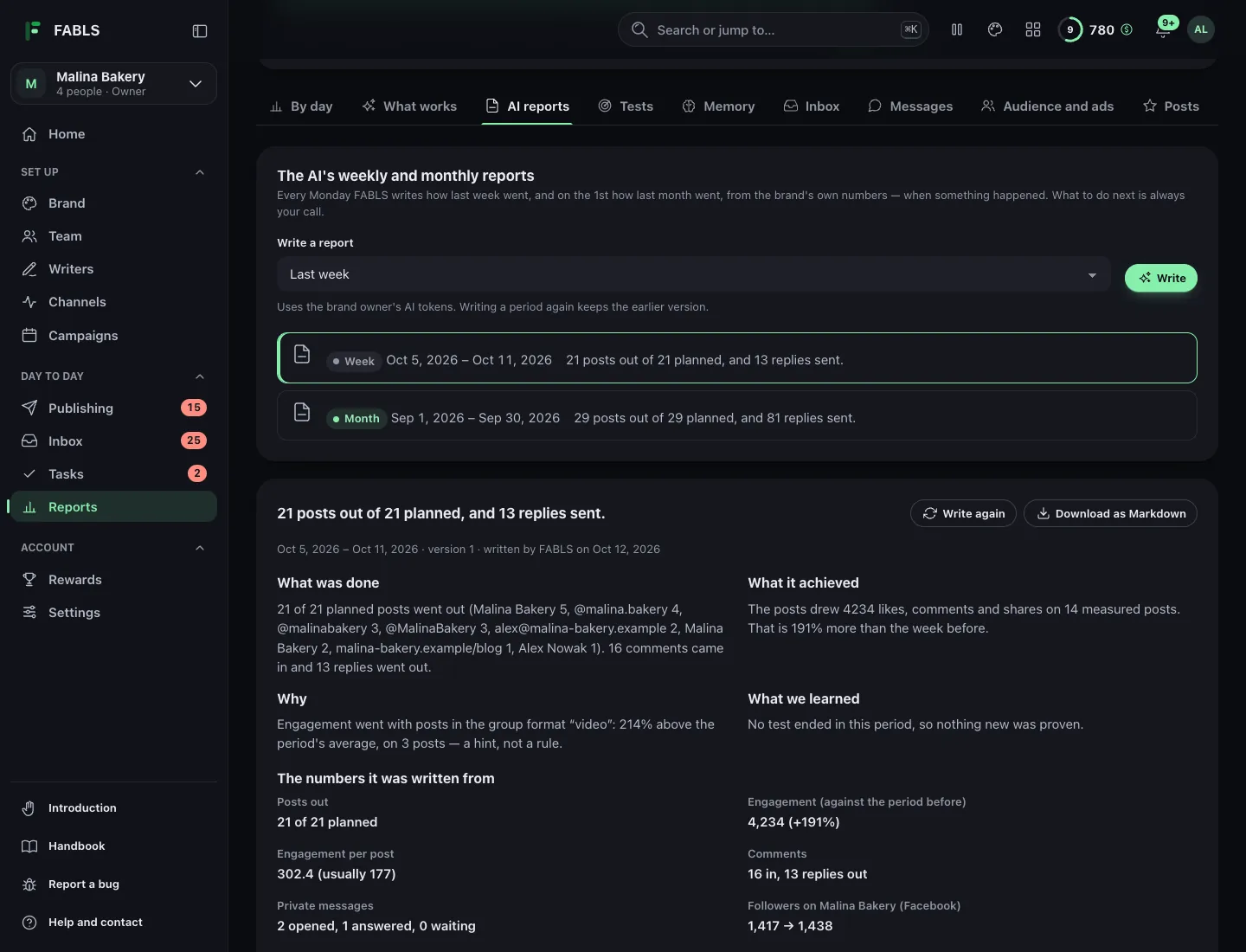
Demo: AI reports: what happened, what it did, why, and the numbers behind it. Malina Bakery is a made-up bakery; every screen here is the real app.
The Brand Ledger
History that was never recorded cannot be rebuilt.
So FABLS records it as it happens. Every action by every actor lands in the brand's ledger: a person, the AI drafting, autopilot, an AI agent with its own token, the worker. It is append-only, it is kept for the brand's whole life, and only deleting the account removes it.
Content has a history too. A post's earlier versions are kept instead of overwritten, and every AI output keeps its own record: the model, what it was for, what it cost in tokens and what became of it, used, edited or discarded. The words of a post and the prompts are not in the ledger, only that it happened.
You read it as a timeline you can filter by channel, actor, type and period, page back to the brand's first day, and download as JSON or Markdown, for yourself or for an AI outside FABLS.
Timeline · InstagramIllustration
1Autopilot turned onBy a manager, for this channel only.
2Post publishedApproved by Ola, drafted by "The editor", hook two of two.
3Comment hiddenBy the channel's policy. Undoable.
!Boost startedApproved by a manager, within the campaign's daily cap.
Who, what, whenKept for the brand's life
The numbers
Kept as a series, never only as a latest value.
A number that is overwritten cannot be compared with last month. Every figure FABLS reads lands in one store, with the day it belongs to.
Each channel, each dayFollowers, reach, impressions, profile visits and link clicks, as far back as the platform's API goes. Each platform gives what it gives; a number it leaves out is shown as missing, never as zero.
Each post, over timeCollected an hour after publishing and after one, three, seven and 28 days, and kept after that, so a post that is still found in March shows it.
Ads and the blogGoogle Ads days are stored with their cost, and the page views of a blog article are counted by the plugin on your own site.
Reports that compare
Not what the number is. What it means.
Each figure comes with the period before it and with your own last 90 days, so it is "good for you" rather than good for nobody in particular. The report cuts posts by pillar, format, platform, weekday, time of day, length and media, and shows how many posts each reading rests on. A group of fewer than three measured posts is never crowned.
On the day chart the report marks what you did, such as a campaign starting, a pillar changing or autopilot going on, and the public holidays and commercial days of your country, so an unusual day carries its context beside it. Days that leave the account's normal band are flagged, and the report says if one fell on a holiday, never as its cause.
Correlation is not cause, and every reading says so by saying how many posts or days it rests on.
1Against OctoberEngagement per post up on the month before, down on your own 90 days.
2By weekdayThursdays lead on 9 posts. Sundays are left out: only two were measured.
3By formatCarousels lead reels, on 11 posts and 8.
·An unusual dayReach jumped on 29 November. The same day: Black Friday.
Every reading shows its sampleContext, never a cause
A hunch, or a test. You choose.
Run the argument instead of repeating it.
Every team has a belief nobody has checked, that posts opening with a question get more comments, or that Tuesday beats Friday. In FABLS you write it down as a statement, with the change the writers will make, the number that should move and a window of a week to four months. The AI can propose tests from the brand's own numbers, up to three at a time, but only a person starts one.
A test runs as alternate weeks, test weeks and usual weeks taking turns so both share a season, or as before and after for a change you have already made. The planner schedules the test slots, the writers are told what is being tried, and at the end FABLS judges it once, in plain words, with how confident it is. With too few posts it says so, instead of a verdict.
Brand memory
What the brand knows, in front of every prompt.
A learning is one sentence with what it rests on: something that works, something that fails, or a fact the numbers cannot show, such as "the rye is baked on Fridays only". Each has a confidence and a start date, and a learning is replaced rather than edited, so the brand keeps what it believed and from when.
A judged test teaches by itself when its result is clear. Everything else enters the memory only when a person accepts it, so the AI proposes and you decide. The planner, the drafts, the replies and the assistant all read the memory before they write, each the slice it needs.
The dossierIllustration
1WorksPhotographs of the counter beat drawn pictures on Instagram. High confidence.
2FailsPosting on Sunday evening. Tested, refuted.
3FactThe rye is baked on Fridays only.
?WaitingTwo proposals from the weekly report, for a person to accept.
Read by planner, drafts and repliesExport as Markdown
The AI's reports
A short one every week. A full one every month.
Stored, versioned and kept for good, written over numbers the code has already counted. The AI tells the story; it does not do the arithmetic.
What was done, and what it achieved
Posts out against the plan, comments and replies, messages answered and waiting, tests started. Then engagement and reach against the period before and against your usual 90 days, the followers gained, and Google Ads.
Why, and what was learned
The posts that led and the posts that trailed, the unusual days, the events from the ledger, the tests judged and the learnings kept. Correlations, labelled as correlations.
What next
Up to five next steps: some advice, some a proposed learning, some a test. One click turns a step into a proposal, once, and a person accepts it. The report is a page in FABLS, and it can be mailed to anyone who asks for it.
Month two is planned from what worked in month one.
That is the loop: the five jobs run into each other, and Learn is where the last one hands over to the first.